Tokenization platforms and regulated stablecoins, engineered like a product. We turn real-world assets into audited on-chain instruments across Ethereum, Stellar, Algorand and 5 more chains, with reserve attestation and redemption under 8 seconds built in. Estonian precision, independently audited since 2019.
Engagements start atEUR 18,000Regulated platform: up to EUR 540,000
Token StandardThe Mint ReviewLedger BalticRWA QuarterlyStable Signal
Blockchain Factory is a blockchain development company based in Tallinn, Estonia, that engineers tokenization platforms and regulated stablecoins for FinTech issuers and enterprise clients. Founded in 2019, it has shipped 124 mainnet contracts with zero critical findings in production.
At a glance
Blockchain development company based in Tallinn, Estonia, niche: asset tokenization (RWA) and regulated euro stablecoin issuance under MiCA
EUR 840M tokenized across 8 chains, 124 mainnet deployments, zero critical findings in production
Redemption under 8 seconds on every live stablecoin deployment, verified in production rather than projected on a roadmap
ISO/IEC 27001:2022 (Bureau Veritas) · ISAE 3402 Type II · MiCA-readiness attestation BF-MICA-2026-014
Audited smart contracts with 0 critical findings, every deployment independently reviewed before mainnet
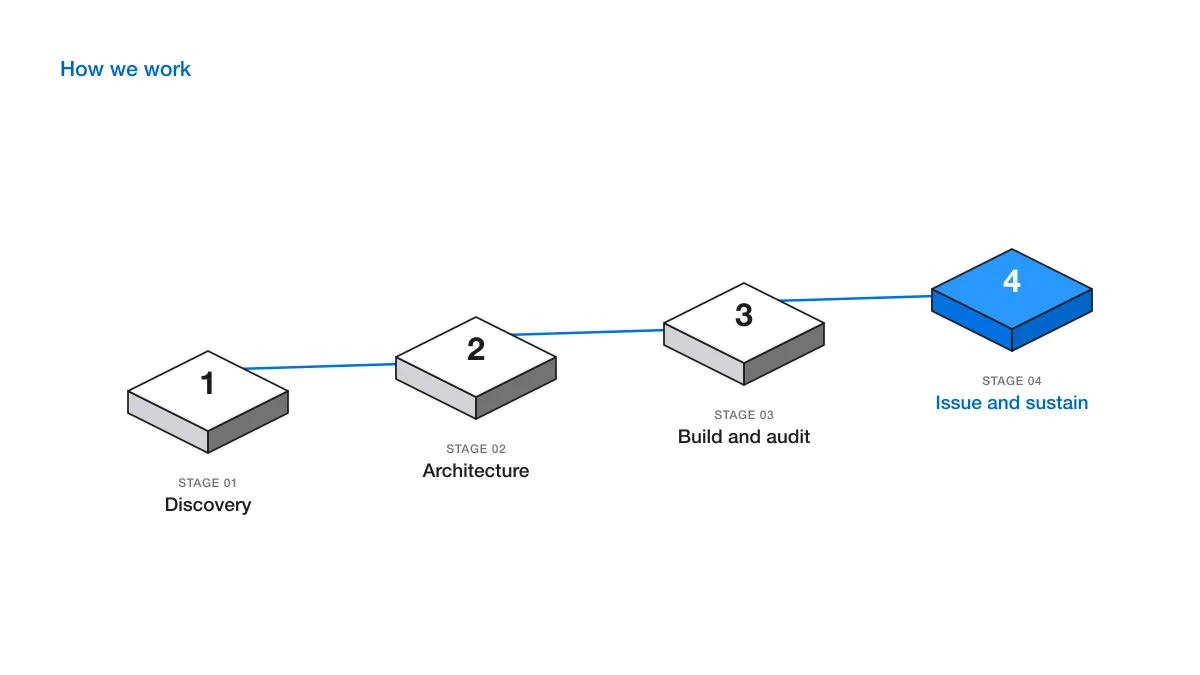
From asset to audited token in 4 defined stages: Discovery, Architecture, Build and audit, Issue and sustain
Fixed-scope or dedicated-team engagements priced in EUR, from EUR 18,000 proof of concept to EUR 540,000 regulated platform
What we make
A factory for on-chain assets
Blockchain Factory assembles regulated token systems from nine engineering blocks rather than one bespoke build per client. Each block ships as production code with its own price, from a tokenization proof of concept at EUR 18,000 to a full regulated stablecoin platform. Every engagement closes with a running system, never a prototype.
01
Asset Tokenization
Real world asset tokenization across bonds, funds and commodities: each turned into an audited, transferable on-chain token with engineered issuance and redemption paths. Our tokenization platform development covers the full stack from smart contract architecture to custody.
From EUR 18,000, the Factory Start price for a tokenization proof of concept.
Stablecoin payment development for FinTech issuers: fiat-backed systems with on-chain reserve attestation, sub-10-second redemption and stablecoin rails development built for MiCA-compliant scale.
Built at Factory Scale, EUR 200,000 to 540,000 for a regulated stablecoin platform.
Secure smart contract development in Solidity and Rust, fuzzed and formally verified before mainnet. Every contract is audit ready and designed with upgradeability planning from day one.
Delivered within Factory Build, EUR 60,000 to 180,000 for an audited production contract.
KYC, transfer restrictions, allowlists and reporting hooks engineered for MiCA-ready issuance. Role-based smart contracts enforce permission design so every wallet sees only what it is allowed.
Scoped into Factory Scale; MiCA compliance work is priced line by line in the SOW, never sold as a stand-alone fee.
Proof-of-reserve pipelines that publish backing on-chain on a fixed cadence, independently verifiable. On-chain data APIs surface reserve and supply figures to auditors in real time.
Built at Factory Scale, EUR 200,000 to 540,000, then maintained under Factory Care from EUR 7,900 per month.
Smart contract security engineering: Slither, Mythril, Foundry fuzzing and Halmos in CI plus manual review. Smart contract audit readiness is built into every sprint, not bolted on at the end.
Included in every edition's fixed price; an added audit cycle adds approximately EUR 12,000 to 25,000.
Cross chain development across eight networks through one compliance abstraction layer. Multi chain integration means a new chain goes live in 1 to 2 weeks without touching your compliance logic.
Priced inside Factory Build, EUR 60,000 to 180,000; three or more chains add 2 to 4 weeks.
DeFi protocol development for lending corridors, staking smart contracts and token-gated platforms wired to your tokenized assets. We cover both DeFi backend development and the on-chain integration layer.
Shipped as part of Factory Build, from EUR 60,000 for a production dApp.
MPC and qualified-custodian integration so issuance and redemption never touch a single hot key. The same architecture keeps redemption under 8 seconds even with a multi-party signing quorum in the loop. Key management and oracle risk management are scoped during blockchain technical discovery, before a line of code is written.
Bundled into Factory Scale, EUR 200,000 to 540,000, alongside compliance and attestation.
We focus on digital asset software development for regulated sectors where on-chain proof matters. Blockchain development for FinTech issuers is our primary lane, but the same tokenization infrastructure applies across:
FinTech and paymentsAsset management and fundsCarbon and ESG marketsReal estate tokenizationCommodity and trade financeDeFi protocolsGovernment and central bank pilots
Engagement models
Fixed-scope
Defined deliverables, fixed price, fixed timeline. Factory Start (EUR 18,000) and Factory Build (EUR 60k to 180k) run as fixed-scope engagements.
Dedicated team
A named squad embedded in your product org, billing monthly. Suited to Factory Scale (EUR 200k to 540k) builds with evolving compliance requirements.
Sustain retainer
Factory Care from EUR 7,900 per month: continuous monitoring, recurring audits, reserve-pipeline upkeep and on-call incident response.
Featured build
Aurelia Mint, a euro stablecoin that proves itself
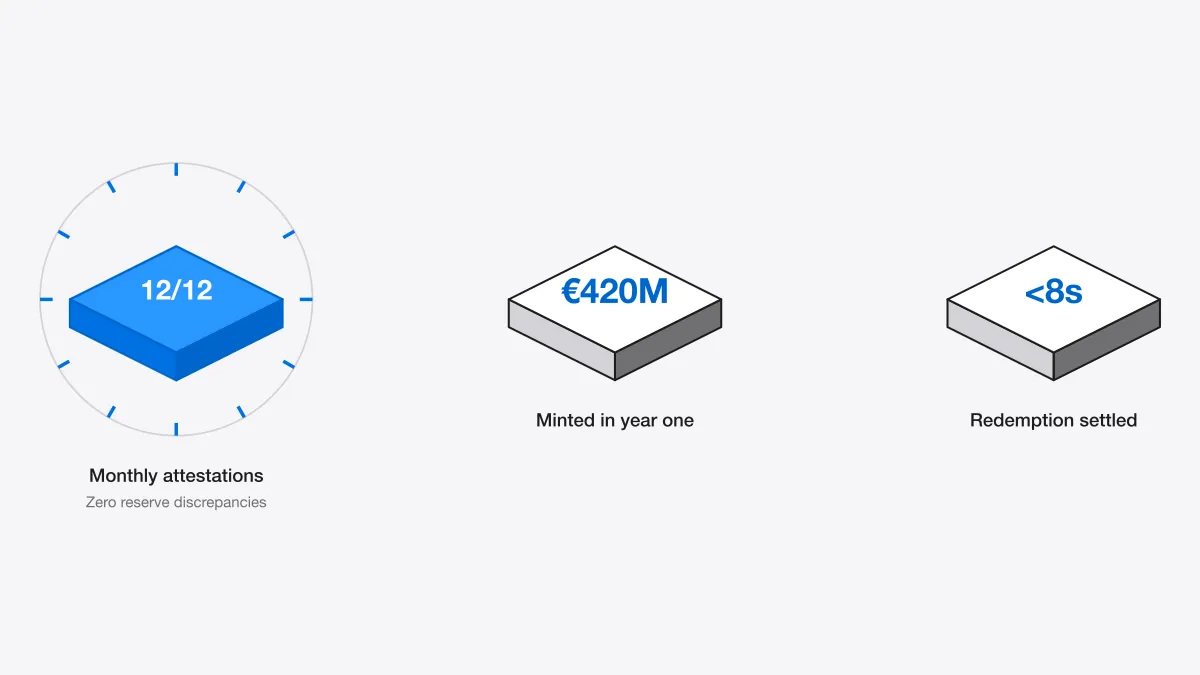
A regulated euro stablecoin where every token in circulation is matched by an attested reserve, published on-chain every month, redeemable in under 8 seconds.
€420MMinted in year one
<8sRedemption settlement
0Reserve discrepancies
How we work
From asset to audited token in four stages
Four fixed stages carry an asset from technical discovery to a live mainnet token. Discovery runs two weeks at a fixed fee and ends in a signed scope document. Architecture, then build with the external audit running in parallel, then issuance with proof-of-reserve live complete the cycle. A production token system takes 6 to 12 weeks.
STAGE 01
Discovery
We map the asset, the reserve, the redemption path and the compliance surface before any code. This blockchain technical discovery phase runs two weeks at a fixed fee and produces a signed scope document.
Timeline
Two weeks, fixed fee.
Responsible role
Blockchain Architect.
Outcome
A signed scope document.
STAGE 02
Architecture
Smart contract architecture, token standard, attestation cadence, custody model and chain choice locked against MiCA-ready requirements. We also define blockchain infrastructure needs and oracle integration points at this stage.
Timeline
Inside the same two-week engagement.
Responsible role
Blockchain Architect.
Outcome
A signed architecture document.
STAGE 03
Build and audit
Scalable blockchain development with Slither, Mythril, Foundry testing and Halmos in CI. Audit ready smart contracts from the first sprint: external audit runs in parallel, never as an afterthought. Smart contract CI CD gates every merge to main.
Timeline
Runs from the first sprint, audit in parallel throughout.
Responsible role
Smart-Contract Engineer, with the Security and Audit Lead on the external audit.
Outcome
Audit-ready contracts gated through CI on every merge.
STAGE 04
Issue and sustain
Smart contract deployment to mainnet with proof-of-reserve live, transaction monitoring, on-call and a documented redemption runbook. The outcome is immediate for Factory Scale holders: redemption under 8 seconds from the first live transaction. On-chain analytics feed the Factory Care dashboard from day one.
Timeline
Ongoing after mainnet, into the Factory Care retainer.
Responsible role
Backend and Integration Engineer for the reserve pipeline, then Factory Care.
Outcome
Mainnet deployment with proof-of-reserve live and a documented redemption runbook.
The people building your platform
Who builds your tokenization platform
Every regulated platform is staffed from a bench of 47 engineers across seven disciplines: architecture, smart contracts, security and audit, MiCA compliance, backend integration, QA and project management. Squad size follows the edition and the scope, but a regulated build never starts with fewer than all seven of those roles filled.
Blockchain Architect
Owns the overall token system design: chain selection, token standard, custody model and attestation cadence. Produces the signed architecture document that anchors the SOW.
Smart-Contract Engineer
Writes the core contracts in Solidity or Rust, runs Foundry fuzz suites and formal verification in CI, and maintains the audit-readiness gating on every merge to main.
Security and Audit Lead
Owns the threat model, runs Slither and Mythril static analysis, coordinates the external audit firm and resolves every finding before mainnet. The 0 critical findings record across all 124 deployments sits here.
Compliance / MiCA Specialist
Translates MiCA reserve segregation, redemption timing and disclosure obligations into contract-level requirements. Maintains the KYC allowlist integration, FATF Travel Rule messaging and the ISAE 3402 controls framework in parallel with build.
Backend and Integration Engineer
Builds the off-chain services that make on-chain state useful: reserve attestation pipeline, Chainlink oracle feeds, Sumsub KYC webhook handlers, The Graph subgraphs and the issuance API. Keeps on-chain and off-chain state in sync.
QA Engineer
Owns integration testing across the full stack from contract events to API responses, writes scenario tests for edge-case redemption flows and manages the test coverage gate that every PR must pass. For Factory Scale engagements, fork tests against the locked chain run before mainnet to confirm redemption under 8 seconds ahead of launch, a settlement-timing check distinct from the functional scenario tests above.
Project Manager
Runs the sprint cadence, maintains the SOW milestone tracker and owns the weekly client status report. The single point of contact for scope, timeline and delivery questions throughout the engagement.
What you receive
Every engagement ships a complete, production-ready package
A repository link is not a delivery. Each Blockchain Factory engagement closes against seven defined artifacts: audited and source-verified contracts, a deployment runbook, the threat model, reserve and attestation hooks, a REST API with SDK, full documentation and a knowledge transfer session. The signed SOW commits the firm to all seven.
Audited and source-verified smart contracts
All contracts deployed to mainnet are independently audited before launch, with the external audit report and all resolved findings handed to you. Source code is verified on Etherscan or equivalent block explorer so any counterparty can confirm the deployed bytecode matches the audited source.
Deployment runbook
A step-by-step operational guide covering chain configuration, constructor parameters, admin key rotation, reserve feed wiring and the mainnet deployment sequence. Written so your internal team can operate and upgrade the system without Blockchain Factory on call for routine procedures.
Threat model
A structured threat model documenting the attack surface of your token system: oracle manipulation vectors, admin key compromise scenarios, redemption replay risks and cross-chain bridge exposure. Used as input to the external audit and retained as a living document for Factory Care engagements.
Reserve and attestation hooks (stablecoin / RWA)
For stablecoin and RWA platform engagements: a Chainlink Proof of Reserve feed wired to your custodian, a scheduled attestation contract that publishes backing on-chain on a defined cadence, and an API endpoint that exposes reserve and circulating supply figures to regulators and auditors in real time.
REST API and SDK
A documented REST API for issuance, redemption, allowlist management and reserve queries, plus a typed TypeScript SDK where the engagement scope includes a frontend or third-party integration. API versioned and backwards-compatible for the duration of the Factory Care retainer.
Full documentation
NatSpec contract documentation, an architecture decision record (ADR) log, integration guides for each connected protocol (Chainlink, Sumsub, Fireblocks, The Graph) and an operator handbook. Stored in your version-controlled repository, not a shared wiki that disappears when the engagement ends.
Knowledge transfer and training
A structured handover session covering the contract architecture, key management procedures, the reserve pipeline and monitoring dashboard, plus a recorded walkthrough your team can replay. Factory Scale engagements include a full-day on-site (or virtual) training session with your engineers and compliance team.
Getting started
Start within 5 working days
First contact to a live discovery sprint takes under a week. Day one is a 45-minute scoping call ending in a written scope outline. Days two and three produce a fixed-price SOW with milestones and IP assignment. Days four and five provision the repository and introduce the squad.
Day 1
Free scoping call
A 45-minute call with Arnold Hilfiger or a senior architect. We map the asset class, the reserve and redemption model, the target chains and the compliance obligations. You leave with a written scope outline and a ballpark edition recommendation by end of day.
Days 2 to 3
SOW and engagement agreement
We turn the scope outline into a fixed-price SOW with defined milestones, IP assignment clauses and a delivery calendar. You own the IP and the source from day one: it is written into the SOW, not implied.
Days 4 to 5
Kickoff and access setup
Repository provisioned in your org, environment setup guide shared, squad introduced. The Project Manager sends the sprint schedule and the first status-report cadence. The discovery sprint starts immediately; no idle time between signing and work.
Week 2
Discovery to architecture hand-off
By the end of week two you have a signed architecture document: token standard, chain selection, custody model, attestation cadence, compliance surface and an audit plan. This document is the build contract for the rest of the engagement and cannot be changed without a signed change order.
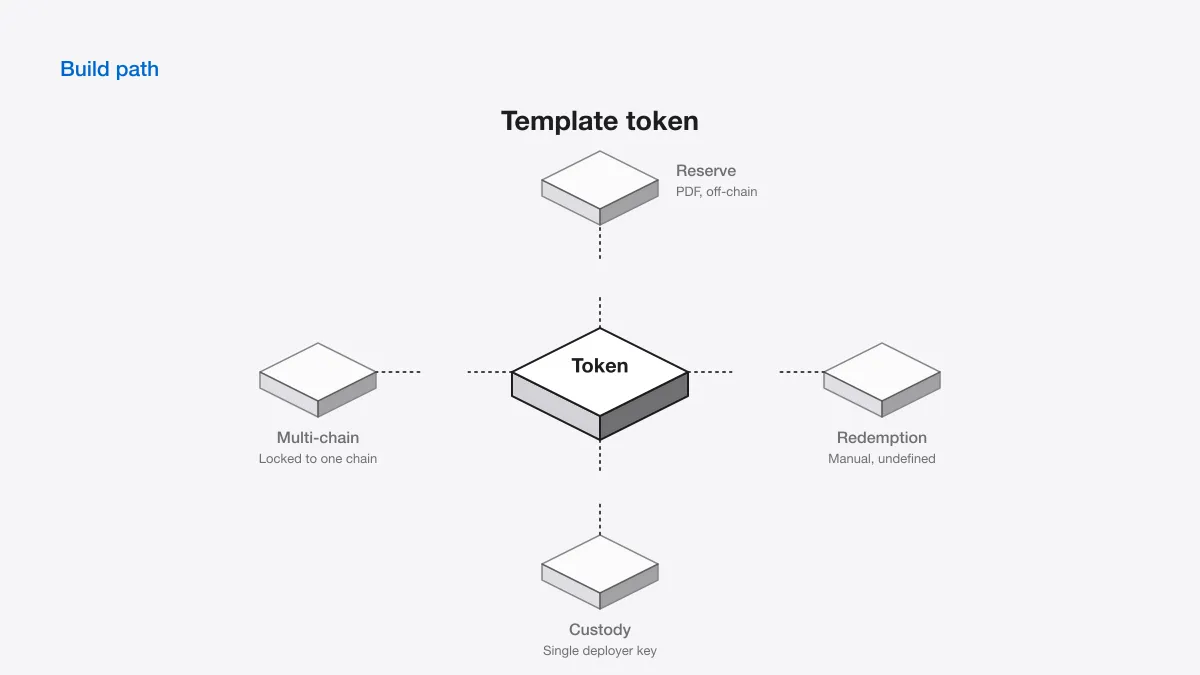
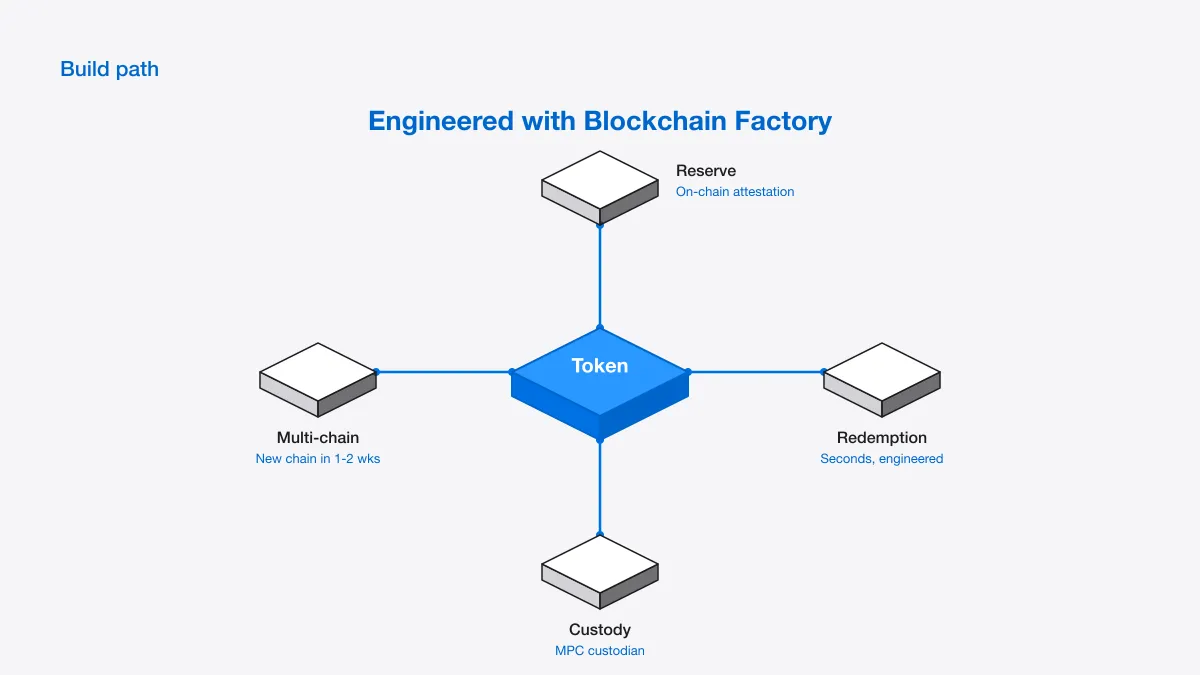
A template token mints quickly and leaves reserve proof, redemption, compliance, custody and multi-chain support undefined. An engineered system treats all of them as the product rather than as follow-up work. The table below sets the two paths against each other across seven factors, from reserve proof through security posture to cost.
Factor
Engineered with Blockchain Factory
Template token
Reserve proof
On-chain attestation on a fixed cadence, independently verifiable
A PDF or a promise, off-chain and unverifiable
Redemption
Engineered redemption path, settled in seconds
Manual, undefined, often the failure point
Compliance
KYC, transfer rules and reporting built for MiCA-ready issuance
Bolted on later, if at all
Security posture
Independently audited, fuzzed and formally verified before mainnet
Inherits the template code and its attack surface
Custody
MPC or qualified custodian, no single hot key
Single deployer key holds the asset
Multi-chain
One compliance abstraction layer, new chains in 1 to 2 weeks
Locked to one chain
Cost
EUR 18,000 to 540,000 by edition, audit included
Cheap to mint, expensive when redemption breaks
Template tokenEngineered with Blockchain Factory
Best fit for engineered: regulated stablecoins, tokenized funds and bonds, anything that must prove its backing. Best fit for a template: testnet experiments with no real asset behind them.
Honest scope
When tokenization is not the answer
Roughly 35 percent of inbound RFPs are declined. Tokenization is the wrong tool when an asset cannot be reliably attested off-chain, when a database already delivers the same settlement and transparency, when no legal counsel has classified the token or when the reserve holder refuses independent on-chain attestation.
Assets that cannot be reliably attested off-chain, so the token cannot prove its backing
Workflows where tokenization adds no settlement or transparency benefit over a database
Token launches without legal counsel on securities classification under MiCA or local law
Consumer products where wallet friction will kill adoption before the asset matters
Reserves held by a party unwilling to support independent, on-chain attestation
Crypto wallet or DeFi platform builds where no blockchain security review is in scope
We decline roughly 35 percent of RFPs. A token that cannot prove its reserve is a liability, not a product.
The risk is concrete. According to the Chainalysis 2024 Crypto Crime Report, USD 1.7 billion was stolen from DeFi protocols in 2023, and a recurring pattern in failed tokenized-asset projects is a redemption and reserve layer that was never engineered to the standard of the token contract itself.
What we build with
Our engineering stack, in full
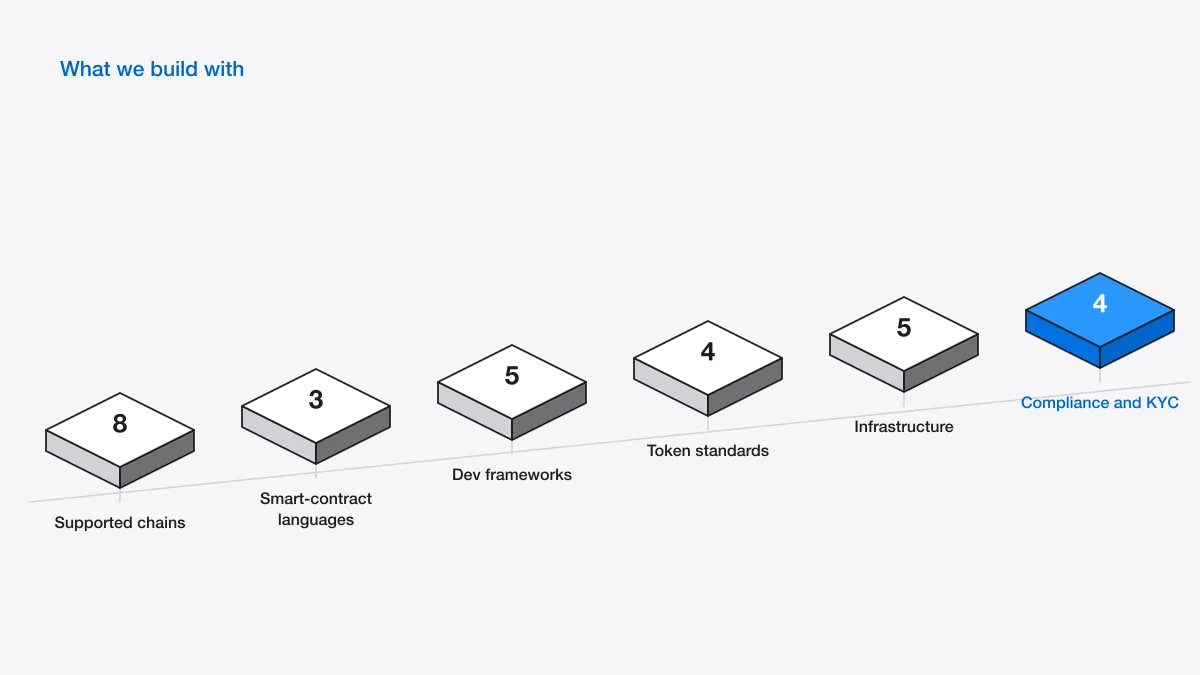
Stack choices at Blockchain Factory are deliberate and auditable rather than fashionable. Solidity and Rust for contracts, Foundry and Halmos for testing and formal verification, Chainlink for oracle feeds, Sumsub for KYC and The Graph for indexing. Every tool listed below runs in production across 124 mainnet deployments.
Stellar Asset Contract (SAC) for on-chain euro stablecoins
Infrastructure
Chainlink Data Feeds and Proof of Reserve
The Graph (subgraph indexing for auditors)
Alchemy · QuickNode (RPC and node access)
Fireblocks (MPC custody integration)
OpenZeppelin Contracts and Defender
Compliance and KYC
Sumsub (KYC/AML onboarding)
Compliant allowlist and transfer-restriction contracts
FATF Travel Rule messaging layer
ISAE 3402 Type II controls framework
Formal verification earns its line in that stack because it answers a question a test suite cannot answer at all.
Unlike regular testing, formal verification can conclusively prove the absence of errors in a smart contract.
ethereum.org, Smart contract security
Infrastructure decisions
Choose the right chain for your tokenization use case
No single chain suits every asset class. Settlement finality, compliance tooling and transaction cost each pull the decision in a different direction for RWA tokenization and regulated stablecoins. The table below maps four deployed architectures against those trade-offs. Chain choice is locked at the architecture stage, never retrofitted afterwards.
Architecture
Best for
Settlement / finality
Compliance fit
Cost profile
Ethereum L1
High-value regulated securities, sovereign bond tokenization, institutional DeFi
12-second blocks, probabilistic finality; high liquidity and deepest tooling
ERC-3643/T-REX transfer restrictions, FATF Travel Rule messaging, Chainlink PoR; MiCA-ready patterns well established
Higher gas; justified for assets where settlement finality and custodian familiarity are paramount
Near-zero fees; suited to high-frequency, low-value transfers where EVM gas would consume a material share of transaction value
Permissioned appchain / subnet
Regulated fund tokenization, bank-issued instruments, government digital-asset pilots
Custom validator set; typically 1-2 second deterministic finality with operator-controlled participant set
Full control over validator whitelist, transaction filtering at consensus layer; no public mempool exposure; meets strictest institutional data-sovereignty needs
Higher infrastructure cost (dedicated validators); offset by regulatory and liability simplification for issuers under heavy supervision
All four architectures are supported by Blockchain Factory through a single compliance abstraction layer. Chain choice is locked during the Architecture stage after reviewing the asset class, investor base and regulatory jurisdiction. A new chain typically adds 1 to 2 weeks to the build timeline.
Security and compliance
Regulated from the architecture stage
For an issuer bringing a regulated token or euro stablecoin to the EU market, compliance is the primary engineering constraint rather than a review gate at the end. MiCA reserve segregation, redemption timing, on-chain KYC allowlists and transfer restrictions all land in the contract architecture before the first sprint.
Regulatory frameworks we engineer for
MiCA (Markets in Crypto-Assets)EU regulation governing stablecoin issuers and crypto-asset service providers. Blockchain Factory holds MiCA-readiness attestation BF-MICA-2026-014 and engineers stablecoin systems to MiCA-compliant reserve and redemption requirements.
AML and KYCOn-chain allowlist and transfer-restriction contracts enforce KYC outcomes at the contract layer, not just at the onboarding portal. Every wallet that can receive a regulated token has been independently verified.
FATF Travel RuleOur compliance abstraction layer includes a Travel Rule messaging layer so token transfers above threshold carry the required originator and beneficiary data without breaking the token’s on-chain atomicity.
FATF RecommendationsWe follow the Financial Action Task Force standards for virtual asset service providers throughout the KYC, due-diligence and suspicious-transaction reporting design.
EU e-money and payment institution rulesStablecoin rails built for FinTech issuers holding e-money licences. We scope reserve segregation and redemption to match EMI and PI licence obligations at the architecture stage.
Standards held
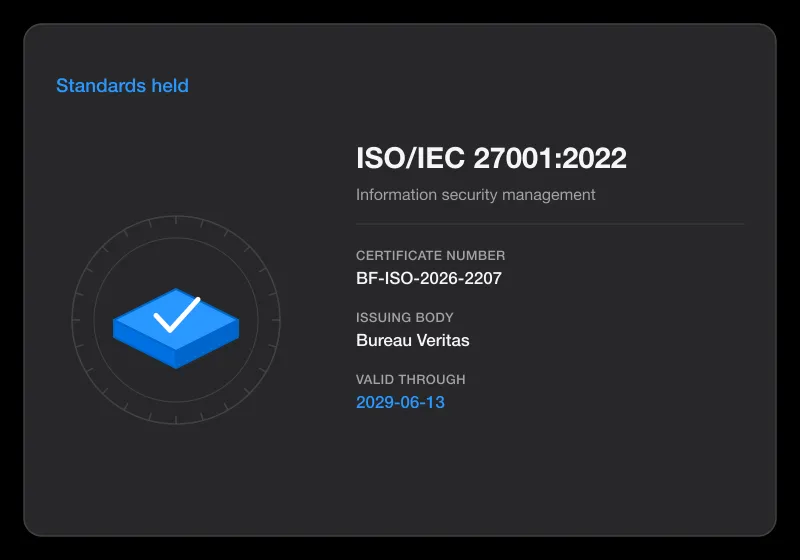
ISO/IEC 27001:2022Certificate BF-ISO-2026-2207, issued by Bureau Veritas, valid through . Scope: information security management for blockchain software development and tokenization services.
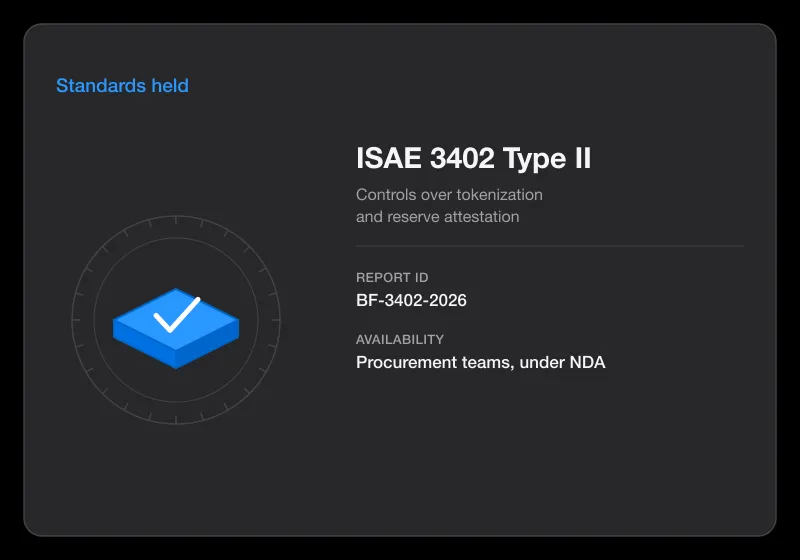
ISAE 3402 Type IIReport BF-3402-2026, covering controls over tokenization issuance and reserve attestation. Procurement teams can request the full report under NDA.
MiCA-readiness attestationReference BF-MICA-2026-014, EU Markets in Crypto-Assets.
Security track record
0Critical findings in production across all 124 mainnet deployments
0EUR funds lost to a Blockchain Factory contract
100%Of 124 deployments independently audited before mainnet launch
€840MIn assets tokenized on audited Blockchain Factory rails
Every euro stablecoin leaving this workshop is engineered against MiCA rather than checked against it afterwards. Its supervisor states the scope in one line.
The Markets in Crypto-Assets Regulation (MiCA) institutes uniform EU market rules for crypto-assets.
European Securities and Markets Authority, Markets in Crypto-Assets Regulation (MiCA)
Production proof
Featured case studies
Both cases below are production deployments carrying live value, not whitepaper concepts. Aurelia Mint runs a euro stablecoin with EUR 420 million minted in year one and redemption settling under 8 seconds. Verdant Registry tokenized 2.4 million tonnes of carbon and cut audit time from six weeks to two days.
Regulated stablecoin, EU
Aurelia Mint euro stablecoin
Challenge
Prove a growing euro reserve on-chain instead of with a PDF, and replace manual, undefined redemption with a settlement path holders and regulators could trust.
What we did
Built the proof-of-reserve pipeline that publishes backing on-chain every month and engineered redemption as a contract path instead of a support ticket.
Result
€420M minted in year one. Redemption under 8 seconds has held across the full first year of live volume, with zero reserve discrepancies across 12 monthly attestations.
Carbon credit tokenization, Global
Verdant Registry carbon tokens
Challenge
Stop the same tonne of carbon being resold after retirement and replace slow spreadsheet exports with an audit trail auditors could query directly.
What we did
Built the registry on EVM contracts with on-chain retirement logic so every credit is retired the moment it is used and auditors verify records directly through on-chain analytics.
Result
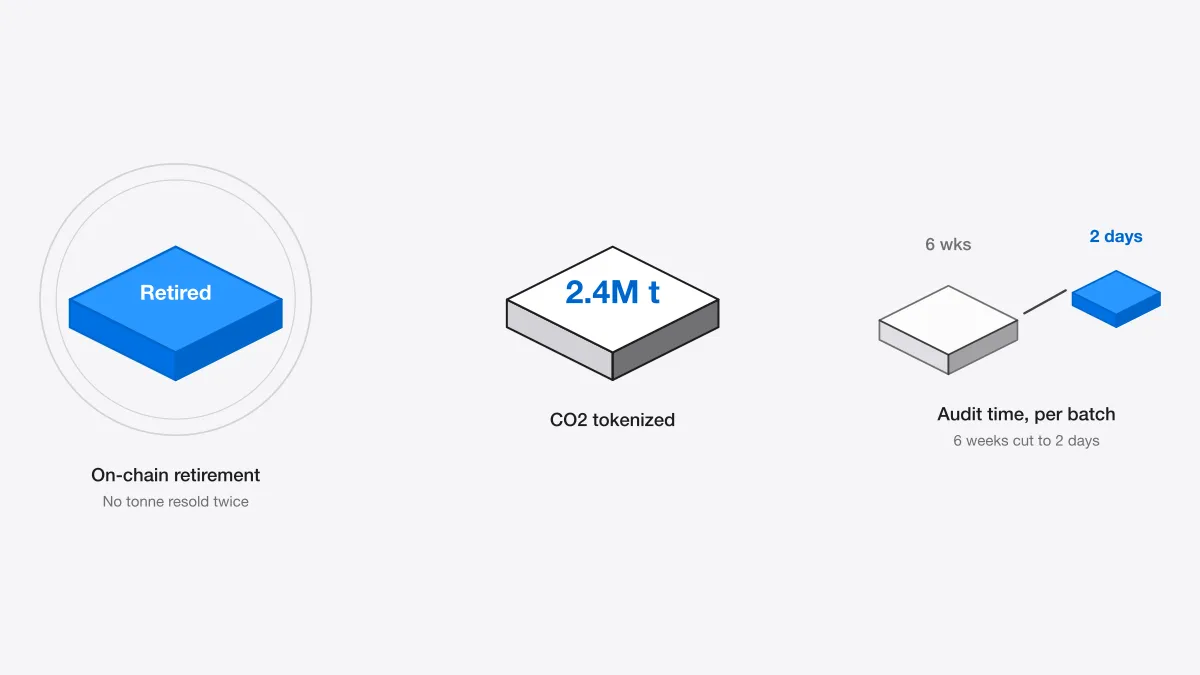
2.4M tonnes of CO2 tokenized, double-counting eliminated and audit time cut from 6 weeks to 2 days.
Screens from production
Inside a live Blockchain Factory build
Three screens pulled from live client deployments, redrawn and anonymised under NDA so nothing identifies the client. They show issuance gated on a live reserve check at Aurelia Mint, on-chain credit retirement at Verdant Registry and a cross-border stablecoin payout corridor at Linna Pay.
Aurelia Mint · IssuanceMinting is gated on a live reserve and compliance check.
Verdant Registry · RetirementCredits retire on-chain, so no tonne is counted twice.
Linna Pay · CorridorCross-border payout on a stablecoin rail with built-in compliance.
Editions
Pick the edition that fits the stage
Four editions cover the whole path. Factory Start is a EUR 18,000 fixed-price proof of concept over three weeks. Factory Build runs EUR 60,000 to 180,000 for a production token system. Factory Scale runs EUR 200,000 to 540,000 for a regulated platform, and Factory Care maintains it from EUR 7,900 monthly.
Factory Start
€18,000fixed, 3 weeks
A tokenization proof of concept on testnet with a working reserve and redemption model.
Every edition carries a fixed price, but which edition applies turns on six drivers: asset class and scope, chain selection, audit depth, integration surface, delivery timeline and MiCA compliance scope. Knowing which of the six bite on a given project turns a first call into real scoping rather than guesswork.
Asset class and scope
A euro stablecoin with a single reserve is simpler than a multi-tranche bond with partial redemption windows. Wider asset scope moves a project from Factory Build toward Factory Scale.
Chain selection
Ethereum mainnet gas optimisation and formal verification add to Factory Build cost. Stellar and Algorand deployments run lighter. Cross-chain issuance on three or more networks adds 2 to 4 weeks.
Audit depth
A Foundry fuzz suite and Slither pass is included in every edition. Halmos formal verification and a full external audit are standard at Factory Scale and optional at Factory Build. Each additional audit cycle adds approximately EUR 12,000 to 25,000.
Integration surface
A self-contained token contract with a single custodian is the baseline. Adding a Chainlink Proof of Reserve feed, a Sumsub KYC pipeline, a Fireblocks MPC wallet and a custom redemption portal each extends the scope. Every integration is priced line by line in the SOW.
MiCA and compliance scope
Stablecoins targeting EU e-money qualification require reserve architecture review, legal counsel coordination and an ISAE 3402 controls framework. This adds a compliance engineering track that typically runs 6 to 8 weeks in parallel with build.
Timeline
A 6-week token system at Factory Build pace costs less than the same scope accelerated to 3 weeks with a larger squad. We do not pad timelines, but compression always costs more. Pressing a Factory Scale to 4 months adds roughly 30 percent.
Choose the right edition
Editions by cost model, timeline and best fit
Blockchain Factory prices by edition rather than by the hour. A fixed price against a signed SOW removes the two largest sources of friction in a token build: scope creep and surprise invoices. The table below sets each edition against its cost model, its timeline and the stage it fits.
Edition
Price (EUR)
Cost model
Typical timeline
Best for
Factory Start
18,000 fixed
Fixed scope
3 weeks
Tokenization proof of concept: working reserve and redemption model on testnet, investor-ready
Factory Build
60,000 to 180,000
Fixed scope
6 to 12 weeks
Production token system or dApp: audited ERC-20/ERC-3643 contract, issuance dashboard, redemption interface
Factory Scale
200,000 to 540,000
Dedicated team
5 to 10 months
Regulated stablecoin or RWA platform with MiCA compliance, ISAE 3402 controls, Chainlink PoR and custody integration
All editions include audit costs and a signed SOW. Editions are not estimates; they are fixed-price commitments. Factory Scale, the regulated-stablecoin edition, is engineered toward one fixed target: redemption under 8 seconds, confirmed once chain choice and custody are locked at the Architecture stage rather than promised as a contractual latency warranty. Request a scope outline
Verifiable pricing
Checked against the market, deliverable by deliverable
Eight deliverables below carry a Blockchain Factory price in EUR next to a publicly published market range in USD for the same work, so the figure can be checked rather than taken on trust. The two currencies sit side by side for context and are deliberately not converted into each other.
Token issuance, cross-chain integration and DeFi work all price into one Factory Build price band rather than three separate invoices.
Deliverable
Our fixed price (EUR)
Typical market range (USD)
What the fixed price covers
Smart contract audit, single contract
Approximately EUR 12,000 to 25,000 per extra audit cycle; first pass included in every edition
$5,000-$250,000 overall market range (Sherlock)
Bundled into every edition's fixed price, only an additional cycle billed on top
Custom dApp MVP build
EUR 18,000, Factory Start
$5,000-$20,000+ (Cleveroad)
Working reserve and redemption model on testnet, not a bare token contract
Token issuance and standards work (ERC-20 / 721 / 1155 class)
EUR 60,000 to 180,000, Factory Build
$20,000-$80,000 (Reown)
Audited, deployed and monitored as part of Factory Build, not a separate line item
Cross-chain integration
EUR 60,000 to 180,000, Factory Build; three or more chains add 2 to 4 weeks
$30,000-$120,000 (Reown)
One compliance abstraction layer across eight networks, priced inside Factory Build
Continuous monitoring, recurring audits and on-call incident response bundled into one retainer
These eight ranges trace to four published sources, Sherlock, Cleveroad, Reown and Alchemy, checked directly on . Figures keep the currency each source publishes: EUR for our price, USD for the market range. Neither column is converted into the other.
How we reduce your risk
Our commitments to every client
A blockchain development company that cannot state its risk posture is itself a risk. Six commitments hold on every Blockchain Factory engagement: a free scoping call, client ownership of IP and source, an external-audit-pass commitment, no vendor lock-in, a defined exit and handover and a fixed price rather than an estimate.
01
Free scoping call and fixed-price discovery
The initial scope call costs you nothing. The two-week Discovery sprint is priced as a fixed fee and produces a signed architecture document. If we cannot agree on scope after discovery, you keep the document and owe nothing more.
02
You own the IP and source code
Full intellectual property assignment transfers to you on final delivery. All contracts, scripts, documentation and tooling are yours from signature. We retain no licence over the delivered work. This is in the SOW, not subject to interpretation.
03
External-audit-pass commitment
Every mainnet deployment is independently audited before launch. If the external audit finds a critical or high-severity finding that was not disclosed to you during build, we resolve it at our cost before the engagement closes. Our track record: zero critical findings across all 124 mainnet deployments.
04
No vendor lock-in
Contracts use open, audited standards (ERC-20, ERC-3643, ERC-1400). Dependencies are documented and replaceable. The compliance abstraction layer is designed so you can replace any integration point (custodian, KYC provider, oracle) without redeploying the core token contract. Your system is yours to operate independently.
05
Defined exit and handover
Every engagement closes with a structured handover: repository transferred to your org, admin keys rotated to your custody, documentation complete and a knowledge-transfer session delivered. If you do not renew a Factory Care retainer, you receive a full off-boarding package at no additional cost.
06
Fixed price, not a cost estimate
Factory editions are fixed-price commitments backed by a signed SOW. Scope changes require a signed change order before work begins; we do not bill retroactively for scope that was not in the original SOW. The single most common complaint about blockchain development shops is unpredictable cost. We remove it by design.
How to choose a tokenization partner and what to ask
Choosing an engineering partner for a regulated token or stablecoin is a high-stakes decision made largely on claims. Six questions below separate firms with production depth from firms with a good deck, covering mainnet evidence, category fit, reserve engineering, MiCA readiness, pricing model and post-launch support.
1. Can you show audited mainnet deployments, not testnet experiments?
Production smart contracts attract scrutiny that testnets never will. Ask for on-chain deployment receipts and the names of the external audit firms that reviewed the contracts before launch. Blockchain Factory has 124 mainnet deployments, every one independently audited, with zero critical findings in production.
2. Have you built the specific system type I need (RWA tokenization, stablecoin or DeFi protocol)?
Asset tokenization, regulated stablecoin engineering and DeFi development each require different expertise: token standards (ERC-20 vs ERC-3643 vs ERC-1400), compliance layers, reserve architecture and custody models are not interchangeable. Ask for case studies in your category, not a generic portfolio.
3. How do you handle reserve attestation and redemption, not just the token contract?
Blockchain Factory Research Note BF-2026-01 found that 58 percent of failed tokenization projects failed at the reserve-attestation and redemption layer, not the token contract. A credible firm engineers the full stack. Ask how the reserve is proved on-chain and what happens when a holder redeems at scale.
4. Are you MiCA-ready, and how do you handle on-chain KYC and transfer restrictions?
If you are issuing a stablecoin or security token in the EU, your engineering partner must understand MiCA obligations for reserve segregation, redemption timing and disclosure. On-chain KYC allowlists and transfer restrictions must be built into the contract architecture, not retrofitted at compliance review. Blockchain Factory holds MiCA-readiness attestation BF-MICA-2026-014.
5. Is pricing fixed-scope or time-and-materials?
Time-and-materials contracts shift all scope risk to the buyer. A blockchain development company that prices by edition, with a signed SOW and fixed deliverables, gives you cost certainty. Factory Build and Factory Scale are both fixed-price with clear milestones. The single most common complaint about development shops is unpredictable cost.
6. What does post-launch support cover, and how are incidents handled?
A token in production needs continuous monitoring, reserve-pipeline upkeep and a documented incident runbook. Factory Care retainers cover all of this from EUR 7,900 per month. Ask whether on-call is genuinely available and what the response SLA is for a reserve discrepancy or a contract exploit.
Three ways to staff a regulated token build, compared on the five factors that decide the outcome rather than on the day rate.
Sourcing model
Cost profile
Time to first line of code
External audit access
Bus factor
Retention risk
In-house team
Salaries and equity run whether or not a build is in flight, and the audit arrives as a separate invoice.
Starts only once an architect and a contract engineer have both been hired and served notice.
You source the firm, book the slot and own closing every finding.
Concentrated. The reserve and redemption design usually sits with one senior engineer.
Yours entirely. A departure mid-build stops the build.
Specialist agency
One fixed price per engagement with the audit cost inside it and nothing carried between projects.
Days. The squad already exists, so the delay is contractual rather than a hiring cycle.
The firm holds the audit relationship and runs the audit in parallel with the build.
Spread across a named squad, so one departure does not take the architecture with it.
Carried by the firm. Staffing the squad for the length of the SOW is its obligation, not yours.
Freelance contractors
Lowest day rate and the least predictable total, because every scope change is billed as it arrives.
Quick to start and slow to align, since each contractor is sourced and briefed separately.
You arrange it, and the engagement usually ends before the finding-resolution cycle does.
Lowest. What was decided and why stays in individual heads.
Highest. Nothing contractual holds a contractor through to mainnet.
Blockchain Factory is the middle column: a squad of 47 engineers across 7 disciplines, fixed prices from EUR 18,000 to EUR 540,000 with the external audit inside the price and a discovery sprint that starts within 5 working days of first contact.
How billing works
Fixed prices, staged payments, clear exits
Billing on a fixed-scope edition tracks the same four stages the delivery path already sets out. What follows describes the typical structure of that billing. The document that actually fixes deliverables, milestones, payment terms and IP assignment for a given engagement is the signed Statement of Work named in the terms of service.
One invoice per completed stage
Discovery, Architecture, Build and audit, Issue and sustain: how we work already names these four as one path every engagement travels. A stage's own written outcome, not a date on the calendar or an hours log, is what opens the invoice for it. How many of those invoices a given edition carries follows its own scope: Factory Build and Factory Scale price as a range and settle stage by stage, while Factory Start prices as one fixed sum, EUR 18,000 for the whole three-week engagement. Factory Care sits outside this pattern entirely: once issue and sustain hands off into the retainer, it is billed monthly, not by stage.
Priced in euro, fixed by the SOW
Every edition above is priced and invoiced in euro. Nothing about invoice timing gets decided after the fact: the delivery calendar written into the signed SOW fixes each stage's due date before that stage begins. A scope change is priced and signed off before that work starts, and nothing outside the original SOW gets billed after the fact. This invoicing structure is typical practice, not a binding offer: the signed SOW is what actually governs your engagement.
If you decide not to continue
The engagement's start already carries a guarantee: if we cannot agree on scope after the initial two-week engagement, you keep the scope and architecture work produced and owe nothing further. That stage-by-stage billing, where it applies, typically extends the same protection through every later stage: tell us before the next one starts, and since only accepted stages are ever invoiced, a stage boundary is also a billing boundary, so the invoicing stops exactly where you do. A Factory Care retainer that is not renewed still closes with a full off-boarding package at no extra cost, the same handover every engagement gets at close. The exact exit terms for your engagement are the ones written into your SOW.
By the numbers
Blockchain Factory at a glance
The custom blockchain development market reached USD 17.5 billion in 2023 and is projected to grow at 87.7 percent CAGR through 2030 per Grand View Research, with real world asset tokenization and stablecoin rails as the leading growth vectors. The figures below set Blockchain Factory's own footprint against that market.
124Mainnet deployments
€840MAssets tokenized
7Years operating
47Engineers
8Chains supported
0Critical findings
56Verified reviews
35%RFPs declined
Source: Blockchain Factory internal delivery registry. Deployment counts verified against on-chain receipts. Review counts as reported by Clutch and G2 as of .
Leadership
About the founder
Arnold Hilfiger founded Blockchain Factory in 2019, carrying Estonian digital-government engineering discipline into tokenization and regulated stablecoin infrastructure. Prior work includes core engineering on the Estonian X-Road data exchange from 2012 to 2016 and payments engineering at a Baltic neobank in the three years before the company was founded.
Arnold Hilfiger
Founder and CEO
MSc Computer Science, University of Tartu (2012)
BSc Software Engineering, Tallinn University of Technology (2010)
Core engineer on the Estonian X-Road digital government data exchange (2012 to 2016)
Payments engineer at a Baltic neobank (2016 to 2019)
I learned engineering inside Estonia's digital state, where a public service either works for every citizen or it does not ship. I brought that standard to tokenization. My team and I have put 124 contracts on mainnet, every one independently audited, with no funds ever lost to our code. We treat the reserve and the redemption as seriously as the token. When clients ask how to build a blockchain platform that actually proves its backing, we start with the audit trail, not the branding deck.
Blockchain Factory started after a 2020 project where a client's tokenized fund passed its contract audit cleanly, then nearly failed at launch because no one had engineered how holders would actually redeem. The token was perfect. The redemption was a spreadsheet. We rebuilt it over six weeks, and "prove the reserve, engineer the redemption" has been the first line of every proposal since.
Research Note BF-2026-01 analysed 39 tokenization projects delivered between 2020 and 2025, separating each into a token-contract layer and a reserve-and-redemption layer. Across the dataset, 58 percent of failed projects broke at the reserve and redemption layer rather than in the token contract, even after a clean audit.
Research Note BF-2026-0131 pages, Arnold Hilfiger and the Blockchain Factory team
Abstract
This note examines why tokenization projects succeed or fail in production. We analyse 39 tokenization projects between 2020 and 2025, separating each into a token-contract layer and a reserve-and-redemption layer. Across the dataset, 58 percent of failed projects failed at the reserve-attestation and redemption layer rather than in the token contract, even when the contract had passed audit. We present a reference on chain architecture for proof-of-reserve and engineered redemption, and quantify its effect across two production deployments. The study draws on blockchain data indexing from on-chain receipts and blockchain analytics sourced from our internal delivery registry.
Key findings
58% of failed tokenization projects failed at the reserve and redemption layer, not the token contract
On-chain monthly attestation reduced reserve disputes to zero across the studied deployments
Engineered redemption brought settlement from days to under 8 seconds on the largest build
Zero funds lost across all 124 mainnet deployments in the studied period
Production ready blockchain platforms with oracle integration outperform custom ad-hoc reserve pipelines by a factor of four on time-to-dispute-resolution
BF-2026-01 reads the failure from the delivery side. Central bank researchers describe the same dependency from the monetary side, where what a tokenised claim is worth turns on where its settlement asset sits.
The full potential of tokenisation is therefore best harnessed by having central bank money reside on the same venue as other tokenised claims.
Bank for International Settlements, III. Blueprint for the future monetary system: improving the old, enabling the new
AI meets tokenization
Emerging AI capabilities for on-chain asset infrastructure
2026 is the first production cycle in which machine learning and on-chain asset infrastructure overlap in ways that matter to RWA tokenization and stablecoin rails. Four intersections are under active engineering at Blockchain Factory, and each is described below in terms of what ships rather than what is speculated.
AI reserve and NAV monitoring
Machine learning models monitor reserve pipeline outputs and net asset value feeds in real time, flagging deviations before the on-chain attestation publishes. For the Aurelia Mint stablecoin, this layer catches reserve pipeline anomalies within minutes rather than waiting for the monthly publication cycle. The system learns expected cadences and raises alerts when custody or pricing feeds deviate from modelled behaviour.
ML-based AML and transaction-risk scoring
On-chain transfer monitoring uses gradient-boosted models trained on FATF-aligned transaction patterns to produce a risk score for each transfer before it settles. High-risk transfers trigger a compliance hold at the contract layer, buying the compliance team time to review. This replaces the batch-mode risk reporting that most token systems still use and aligns with FATF Travel Rule expectations for near-real-time monitoring.
AI data oracles for RWA valuation
Real-world asset tokenization depends on reliable, manipulation-resistant price feeds for the underlying: bond yields, commodity spot prices and real estate indices. We integrate Chainlink Data Feeds augmented with ML-based outlier detection so that a single manipulated price source does not flow into the on-chain NAV unchallenged. The oracle layer cross-validates multiple sources and quarantines outliers before they reach the reserve attestation contract.
Anomaly detection for smart contract events
Production token systems emit thousands of on-chain events per day. An unsupervised anomaly detection layer watches event streams from our deployed contracts and flags unusual patterns: minting bursts outside business hours, redemption spikes from unfamiliar wallet clusters, governance proposals submitted with atypical vote cadences. The system feeds our Factory Care on-call workflow and reduces mean time to detection for a security incident from hours to minutes.
Integrations and ecosystem
The protocols we connect your token system to
A firm that only writes contracts delivers half a system. Every regulated token or stablecoin Blockchain Factory ships is wired into four production protocols: Chainlink for oracle data, The Graph for indexing, Fireblocks for custody and Sumsub for KYC. Those integrations are what make a token trustworthy in operation.
Oracle network for price feeds and Proof of Reserve
We use Chainlink Data Feeds to supply audited price data to NAV calculations in tokenized fund contracts and Chainlink Proof of Reserve to publish on-chain attestations that the custodian’s fiat balance matches circulating token supply. The PoR feed is the backbone of every MiCA-ready stablecoin reserve architecture we build.
We deploy custom subgraphs that index token issuance, transfer, redemption and retirement events so auditors, regulators and issuers can query the full on-chain record in real time. The Verdant Registry carbon-credit case study cut audit time from 6 weeks to 2 days because the auditor queried the subgraph directly instead of requesting spreadsheet exports.
Fireblocks MPC wallets remove the single-hot-key risk from every issuance and redemption operation. We integrate the Fireblocks API with our issuance contracts so that no single party can unilaterally mint or burn tokens: a quorum of co-signers is required for every governance action. This is the standard custody model for all Factory Scale stablecoin and RWA platform engagements.
We integrate Sumsub’s identity verification API to push KYC outcomes directly to our on-chain allowlist contracts. A wallet is added to the transfer allowlist only after a verified Sumsub check returns approved. This means compliance is enforced at the contract layer, not just at the portal, so no transfer can occur outside the AML-cleared set of addresses regardless of how the token is accessed.
Verified client reviews
Verified client reviews
Blockchain Factory holds 4.9 out of 5 on Clutch from 35 verified reviews and 4.8 out of 5 on G2 from 21 reviews. Both platforms calculate and publish those scores independently of the company. The figures were last confirmed in and the five reviews below are dated individually.
4.9 / 5
★★★★★
Clutch · 35 reviews
4.8 / 5
★★★★★
G2 · 21 reviews
Clutch and G2 calculate and publish these scores on their own platforms, independent of Blockchain Factory. The figures above were last confirmed in .
IS
Ingrid Sokk
CEO at Aurelia Mint
★★★★★
Blockchain Factory built our euro stablecoin so the reserve proves itself on-chain every month. We minted 420 million euro in year one, redemption settles under 8 seconds and we have had zero reserve discrepancies. They engineered the parts other vendors hand-wave.
€420M minted, redemption under 8s
Clutch ·
ML
Mathias Lindqvist
Head of Product at Verdant Registry
★★★★★
We tokenized 2.4 million tonnes of carbon and on-chain retirement killed double-counting for good. Audit time dropped from 6 weeks to 2 days because auditors verify the registry directly.
2.4M tonnes, audit 6 weeks to 2 days
G2 ·
PK
Priit Kask
CTO at Linna Pay
★★★★★
Our payment corridor settles on a stablecoin rail with compliance built into the contract. Fees fell 58 percent versus our legacy provider and every transfer is auditable on-chain.
Settlement fees down 58%
Clutch ·
DR
Daniela Rossi
Founder at Olivetti Bonds
★★★★★
They tokenized our bond issuance with T+0 settlement and a clean compliance model. Investors see the same on-chain state we do. It changed how our desk thinks about settlement.
Tokenized bonds, T+0 settlement
G2 ·
KM
Kwame Mensah
Director of Engineering at Sankofa Remit
★★★★★
Blockchain Factory built our stablecoin remittance corridor with payout under 30 seconds and KYC enforced on-chain. They told us plainly which features did not need a blockchain, which we respected.
Stablecoin corridor, payout under 30s
Clutch ·
Certified and recognised
Audited, certified, recognised
Every certification listed carries a certificate number and a named issuing body, so each can be checked at source rather than accepted from a logo. Blockchain Factory holds ISO/IEC 27001:2022 through Bureau Veritas, an ISAE 3402 Type II report and MiCA-readiness attestation BF-MICA-2026-014.
ISO/IEC 27001:2022
Certificate BF-ISO-2026-2207
Issued by Bureau Veritas · valid through
ISAE 3402 Type II
Report BF-3402-2026
Controls over tokenization and reserve attestation · available to procurement teams under NDA
MiCA-readiness attestationEU Markets in Crypto-Assets reference BF-MICA-2026-014Read more ↗
Clutch Top Blockchain Developers 2026Ranked #6 in the Baltics, 4.9 / 5 from 35 verified reviewsView on Clutch ↗
G2 High Performer Winter 2026Tokenization category, 4.8 / 5 from 21 reviewsView on G2 ↗
Bureau Veritas Process Excellence Seal 2025Tokenization process assessment, TallinnRead citation ↗
Last reviewed on by Arnold Hilfiger, Founder and CEO at Blockchain Factory. Every figure on this page reflects Blockchain Factory delivery data as of that review date, not a marketing estimate. We build blockchain software, not financial products, so investment advice, securities classification and money transmitter services all fall outside what we do here.
Glossary of technical terms
Tokenization
Representing an off-chain asset, a euro, a bond, a tonne of carbon, as a token whose issuance, transfer and redemption are governed by smart contracts.
Stablecoin
A token designed to hold a stable value, usually by being backed one-to-one by a fiat reserve. The engineering challenge is proving and redeeming that reserve.
Proof of reserve
An on-chain, independently verifiable attestation that the assets backing a token actually exist and match the circulating supply, published on a fixed cadence.
Redemption
The path by which a token holder exchanges a token back for the underlying asset. In tokenized-asset projects this is the most common point of failure.
On-chain retirement
Permanently marking a token as used (for example a carbon credit) so it cannot be sold or counted twice. The standard defence against double-counting.
MiCA
The EU Markets in Crypto-Assets regulation, which sets requirements for stablecoin issuers and crypto-asset service providers across the European Union.
MPC custody
Multi-party computation custody, where a key is split across several parties so no single party can move funds alone. Used to remove single-hot-key risk from issuance.
Formal verification
Machine-checked proof, built with a tool such as Halmos or Certora, that a contract's behaviour matches its written specification for every input it could ever receive, not just a sampled few.
Compliance abstraction layer
A normalisation layer that applies KYC, transfer rules and reporting consistently across chains, so a token behaves the same everywhere it is issued.
Smart contract integration
Connecting an audited token contract to external systems: custody providers, KYC APIs, reserve data feeds and off-chain databases. Smart contract integration defines how on-chain state and off-chain state stay in sync.
Blockchain infrastructure
The node, indexer and RPC layer that sits beneath a token system. Reliable blockchain infrastructure ensures that on-chain events reach off-chain systems without gaps or reorgs causing silent data loss.
Oracle integration
Connecting a smart contract to a trusted external data source, such as a reserve custodian or a price feed. Oracle risk management is one of the first items we address in the architecture stage because oracle manipulation is a leading attack vector in DeFi.
Update log
Conversion upgrade. Added a sticky call-to-action bar, priced service cards, a sourced benchmark table, case-study and certificate imagery, a commercial-terms section and a schema-exact FAQ container. Fixed colour contrast to AA and removed every inline style. Re-authored the privacy, editorial and disclaimer copy that had been shared boilerplate across the portfolio.
Initial publication of the Blockchain Factory landing. Documented the Aurelia Mint and Verdant Registry case studies, the productized editions and Research Note BF-2026-01. Every chain coverage claim, price band and audit figure was checked before this page went live.
Published Research Note BF-2026-01 on reserves, redemption and on-chain proof after analysing 39 tokenization projects.
Renewed ISO/IEC 27001 certification with Bureau Veritas through 2029. Added Near to the compliance abstraction layer.
Editorial policy
Every page on blockchain-development-company.site is owned by a named author and reviewed at least once per quarter. We keep one internal ledger of delivery records, and every statistic, price and timeline on this page is checked against that ledger's most recently closed quarter before publication.
Sources of truth:
Mainnet deployment counts come from on-chain deployment receipts in our internal registry
Tokenized-value and reserve figures come from production attestation data exported under client NDA
Client metrics are reproduced verbatim from signed case-study agreements
Market context citations link to the underlying public report; we paraphrase but do not modify the cited figure
Corrections: if you find an error, email editorial@blockchain-development-company.site with the URL, the line and the correction. Every correction we accept lands in the Update log above with a date stamp, and you will hear back from us confirming it within one business day.
Independence: Blockchain Factory has no paid sponsorships on this page. When we name a tool such as Slither, Mythril, Foundry or Halmos, it is because we actually run it in production, not because anyone paid for the mention.
Privacy policy
Last updated:
This page is operated by Blockchain Factory OÜ, Maakri 19/1, 10145 Tallinn, Estonia, VAT EE102558417.
What we collect:
Server access logs: your IP address, the browser's user agent string, the URL requested, a timestamp and the HTTP status code we returned. We keep these entries for 30 days to support security monitoring, then delete them for good.
Contact form: whatever you type stays between you and Blockchain Factory; we do not pass it to third parties or write anything to your browser. Prefer email? Every address on this page reaches a real inbox, and we reply within one business day.
No analytics, no third-party trackers: every script on this page ships from our own servers, never someone else's. No tracking tags, no advertising pixels, no social embed cookies.
Your rights under GDPR: you may access your data, have it corrected, have it erased, receive a portable copy, restrict how we use it or object to that use outright. To exercise any right, email privacy@blockchain-development-company.site. Article 12 of GDPR caps our response time at 30 days, and that is the outside limit we hold ourselves to, not the target.
Cookies: none. We do not drop a tracker, a fingerprint or a session ID into your browser either.
International transfers: our servers are located in the EU. Your data does not leave the EU unless you explicitly engage us for a project that requires non-EU processing, under Standard Contractual Clauses.
Data Protection Officer:Liis Saaremae, dpo@blockchain-development-company.site
Terms of service
Last updated:
By accessing blockchain-development-company.site you agree to these terms. The page is provided as marketing information about Blockchain Factory services.
1. No advice. Nothing on this page is legal counsel, financial advice, investment advice, a securities opinion or tax guidance. Blockchain Factory builds blockchain software. We will not tell you whether a given token counts as a security in any jurisdiction, how crypto assets should be taxed or whether you are compliant with regulation beyond what our signed engagement covers.
2. Scope of services. Engagements with Blockchain Factory are governed by a separate signed Statement of Work that defines deliverables, milestones, payment terms, IP assignment and warranties. The edition prices and timelines on this page are indicative ranges from prior projects, not binding offers.
3. Smart contract and tokenization risk. Tokenized assets and smart contracts deployed at client direction carry inherent risk including code-level vulnerabilities, reserve and redemption failures, oracle manipulation, governance attacks, third-party dependency failures and chain reorgs. Blockchain Factory warrants delivery of audited code per the SOW, not the absence of all possible risk.
5. Limitation of liability. To the maximum extent permitted by applicable law, Blockchain Factory is not liable for indirect, incidental, special or consequential damages arising from your use of this page or any content linked from it.
6. Governing law. Estonian law. Exclusive venue: Harju County Court, Tallinn, Estonia.
Certifications and verification
ISO/IEC 27001:2022: Information security management
Certificate number: BF-ISO-2026-2207
Issuing body: Bureau Veritas
Issued , valid through
Scope: information security management for blockchain software development and tokenization services
ISAE 3402 Type II
Report ID: BF-3402-2026
Scope: controls over tokenization issuance and reserve attestation
Ask and we will share the full report with your procurement team once an NDA is in place.
Regulatory and assessment
MiCA-readiness attestation, EU Markets in Crypto-Assets, reference BF-MICA-2026-014
Bureau Veritas tokenization process assessment, 2025
Twelve questions below cover what buyers ask most often before a regulated token or stablecoin engagement: what the work involves, what it costs, how to choose a partner, which chains are supported, how audits run, how pricing is structured, how long a build takes and how MiCA applies.
What does a blockchain development company do?
A blockchain development company designs and builds software that runs on distributed ledger networks. This includes smart contracts that govern token issuance and transfer, tokenization platforms that represent real-world assets on-chain, DeFi protocols, dApps and the compliance and custody infrastructure that makes those systems production-ready.
Blockchain Factory specialises in the tokenization and stablecoin segment, where the engineering challenge extends beyond the token contract to the reserve attestation and redemption layer.
Blockchain Factory's blockchain engineering team handles smart contract development, blockchain backend development, on-chain compliance and the reserve pipeline as a single integrated system.
How much does it cost to hire a blockchain development company?
Cost varies by scope. A tokenization proof of concept runs from EUR 18,000 fixed (Factory Start, 3 weeks). A production token system or dApp costs EUR 60,000 to 180,000 (Factory Build).
A regulated stablecoin or RWA platform with attestation, compliance and custody integration costs EUR 200,000 to 540,000 (Factory Scale). Ongoing monitoring and audit retainers start from EUR 7,900 per month (Factory Care).
All editions include audit costs. These are not estimates: every Factory Build is a fixed-price Web3 product development engagement with a signed SOW.
How do I choose a blockchain development company?
Look for independently audited mainnet deployments, not just whitepaper experience. Check that the team has built the specific system type you need: tokenization, stablecoins, DeFi and dApps each require different expertise.
Verify that the company's audit reports exist and are from recognised third-party firms. Ask how the team handles reserve attestation and redemption engineering, not just the token contract.
A capable blockchain technology partner publishes its certification numbers and links to verified review profiles. Blockchain Factory does exactly that: Clutch, G2 and certificate numbers are all on this page.
What does it mean to tokenize a real-world asset?
Real world asset tokenization represents an off-chain asset, a euro reserve, a bond, a tonne of carbon, as a token whose issuance, transfer and redemption are governed by audited smart contracts. The hard part is not the token, it is proving the reserve and settling redemption.
We engineer the attestation and redemption layer with the same rigour as the contract. On Aurelia Mint, our production euro stablecoin, that engineering keeps redemption under 8 seconds. It is the number holders notice, not the token standard underneath it.
Our token system development work always includes the custody model, the compliance abstraction layer and the on-chain analytics feed.
What chains do you support?
Blockchain Factory supports Ethereum, Polygon PoS, Avalanche, Stellar, Algorand, Gnosis Chain, Celo and Near. Our cross chain development uses a single compliance abstraction layer so a new chain goes live in 1 to 2 weeks.
We choose chains for settlement finality, compliance tooling and cost rather than hype.
Multi chain integration is scoped at the architecture stage, not as a retrofit.
Do you offer smart contract audits?
Yes. We run Slither, Mythril, Foundry testing and Halmos in CI plus manual review, and every one of our 124 mainnet deployments was independently audited before launch.
Smart contract security is built in from the first sprint: we use threat modeling, Foundry fuzzing and formal verification, then coordinate the external audit in parallel with the final integration sprint.
There are zero critical findings in production and no funds have been lost to a Blockchain Factory contract.
How is your pricing structured?
We price as fixed editions. Factory Start runs from EUR 18,000 for a tokenization proof of concept (3 weeks) and Factory Build costs EUR 60,000 to 180,000 for a production token system or dApp.
Factory Scale costs EUR 200,000 to 540,000 for a regulated stablecoin or RWA platform and Factory Care starts from EUR 7,900 per month for monitoring, audits and on-call.
This is blockchain product development services with predictable cost: no hourly burn, no scope creep billing.
How long does a typical project take?
Blockchain technical discovery takes 2 weeks. A token system takes 6 to 12 weeks.
A regulated stablecoin or RWA platform takes 5 to 10 months including the external audit cycle.
The audit cycle is never a surprise because smart contract CI CD flags issues in every sprint, not at the end.
When do you say no?
We decline roughly 35 percent of RFPs.
We say no when tokenization adds no settlement or transparency benefit over a database, when an asset cannot be reliably attested off-chain and when a token launch lacks legal counsel on securities classification under MiCA or local law.
We also decline when a prospective client wants to build a crypto wallet or DeFi platform without any blockchain security review in scope.
What token standards do you use for security tokens and RWA?
For permissioned security tokens and real-world asset tokenization we use ERC-3643 (the T-REX standard) and ERC-1400, both of which embed transfer restrictions and compliance rules at the contract level rather than at the portal.
For fungible stablecoins the baseline is ERC-20 with a custom compliance abstraction layer that adds KYC allowlisting and MiCA-aligned redemption logic.
We choose the standard at the architecture stage based on the asset class, the investor base and the regulatory jurisdiction.
How do you handle KYC and transfer restrictions on-chain?
Our compliance abstraction layer pushes KYC outcomes from Sumsub directly to an on-chain allowlist. A wallet address is added to the transferable set only after the identity check returns approved.
Transfer-restriction contracts then enforce the allowlist on every token movement, regardless of whether the transfer originates from our issuance portal or from an external wallet.
Because the allowlist check lives in the contract itself, compliance is a contract property, not a portal policy. It cannot be bypassed by interacting with the contract directly.
What is MiCA and does it affect my stablecoin project?
The EU Markets in Crypto-Assets regulation sets binding requirements for stablecoin issuers and crypto-asset service providers operating in or targeting the European Union. It defines reserve segregation, redemption timing, disclosure and authorisation requirements for e-money tokens and asset-referenced tokens.
If you are issuing a euro stablecoin or any token backed by a fiat reserve and targeting EU holders, MiCA applies.
Blockchain Factory holds MiCA-readiness attestation BF-MICA-2026-014 and engineers stablecoin systems to MiCA-compliant reserve and redemption standards from the architecture stage.
Get in touch
A scoping call with Blockchain Factory runs 45 minutes and ends with a written scope outline and an edition recommendation, at no cost and with no obligation. The Tallinn office takes enquiries by email, and a signed SOW can follow within three working days.
Tell us about the asset you want to tokenize. Expect a reply inside one business day.